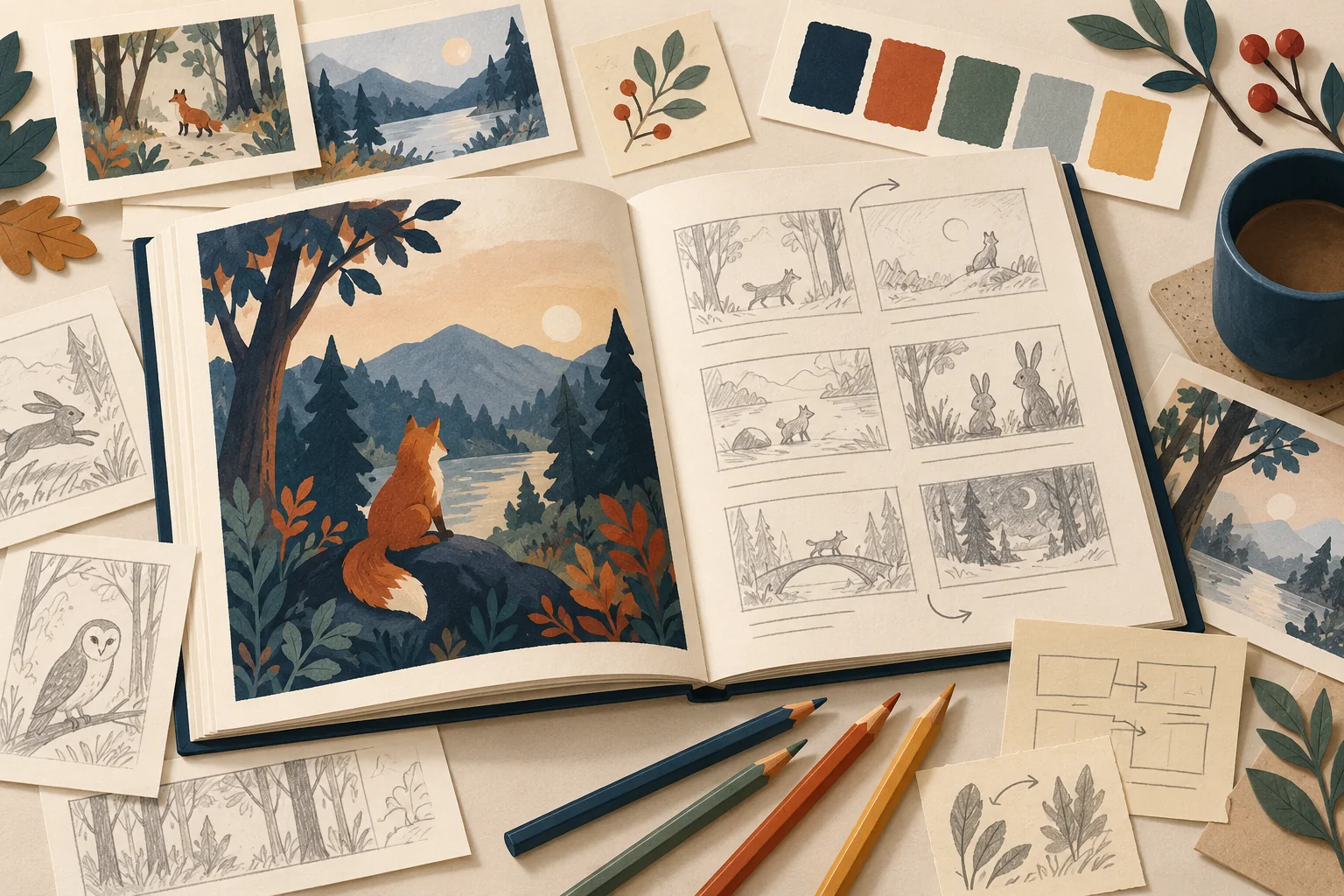
A children’s book has two audiences: the child who experiences it and the adult who decides whether to buy it. A cover may attract that adult, but a satisfying story, readable pages, and an accurate description must support the decision. Selling is never guaranteed. The practical goal is to make a book worth choosing and remove avoidable reasons for disappointment.
Consider a fictional picture book about a fox who wants to plant a garden before the rain arrives. This example will guide the decisions below. It is an invented planning exercise, not a published bestseller or a sales case study. The same method can help an independent author assess a manuscript before paying for final illustrations.
Define one reader and one reading situation
Write a brief describing who will use the book, how they will read it, and what experience they should have. “Children ages three to eight” leaves too many editorial decisions unresolved. “An adult reads a playful garden story aloud to a preschool child” gives the writer a clearer starting point. Age labels should reflect the actual content and testing, not a desire to reach the largest audience.
Add practical constraints: language, intended format, approximate reading session, and whether the book is a story or an activity resource. A coloring book needs instructions and usable drawing spaces. A picture book needs narrative movement. Trying to combine every possible benefit can make both products less satisfying. Keep a separate list of ideas that belong in a later title.
Give the story a visible problem
For the garden example, the fox wants to sow seeds before a storm. That is easier to dramatize than “the fox learns an important lesson about perseverance.” A reader can see the problem, the attempts, and the consequences. Write a one-sentence outline covering the character, goal, obstacle, and final choice. If you cannot identify the character’s choice, the ending may depend too heavily on an adult or narrator solving everything.
Next, list three attempts that genuinely change the situation. The fox might choose a shady patch, spill the seeds, and ask a neighbor to help organize them. Each event should earn its space. Repeating the same obstacle with different scenery adds pages without adding story. Let the character’s final action answer the problem introduced near the beginning.
Separate words from illustration work
Make two columns for each scene: what the text communicates and what the image communicates. If both columns say “the fox carries a red watering can,” you may be paying twice for the same information. The words could instead reveal the fox’s mistaken confidence while the illustration shows a leaking can. That creates a useful relationship between text and picture.
Prepare a rough page plan before commissioning polished art. Use boxes and stick figures. Mark important reveals after page turns and reserve calm space where words must remain readable. Do not force a complete story into a predetermined layout simply because a template exists. Our guide to planning children’s book pages explains how to turn that rough plan into a reviewable production document.
Test the manuscript aloud
Read the draft without stopping to explain it. Mark sentences that require a second breath, pronouns whose meaning becomes unclear, and words that sound unnatural in conversation. Then ask another adult to read it. Their pauses can reveal problems that familiarity hides. A beautifully written sentence may still be awkward for repeated bedtime reading.
With a caregiver’s permission, observe a small reading session with intended readers. Record where attention shifts, where a child asks a useful question, and where an explanation is needed. Do not treat one child’s reaction as a universal verdict. Look for repeat problems, revise, and try again. Avoid collecting children’s names or publishing their comments or images without appropriate permission.
Check production before setting a price
Choose the print format using the book’s needs and KDP’s current options. Color illustrations, page count, and trim size affect the production choices. Use Amazon’s live tools for current printing costs rather than a remembered price from another title. Build a simple worksheet containing the proposed list price, the current estimated royalty, and your own editing and illustration budget.
For a hypothetical project with $300 in upfront production costs and an estimated $3 contribution per copy, recovering that expense would require 100 copies before other costs. Those numbers illustrate arithmetic, not an earnings forecast. Advertising, returns, taxes, and other expenses can change the result. A low list price is not automatically an affordable business model.
Make the listing match the book
Use the actual title, contributors, language, and appropriate reading information consistently across the cover and listing. A parent should not discover that a promised storybook is mostly blank activity pages. Describe what the reader will find, show representative content where the platform permits it, and avoid unsupported claims such as “guaranteed to improve reading ability.”
The description should introduce the experience and give adults enough detail to judge suitability. Our Amazon book description guide includes a worked example. Treat keywords as a way to describe the book accurately, not an invitation to insert unrelated popular titles. A relevant audience is more useful than attention from people who expected something different.
Verify rights and inspect a proof
Keep a record of illustration agreements, font licenses, and any other permissions. Check Amazon’s KDP content guidelines before publishing, including its disclosure requirements for AI-generated text, images, or translations. Editing generated material does not automatically change how Amazon classifies it. The publisher remains responsible for the finished book’s quality and rights.
Inspect the digital preview and a physical proof when available. Check page order, cropped details, small text, dark illustrations, and the relationship between the cover and interior. A file that passes an automated upload check can still produce an uncomfortable reading experience. Record corrections by page number so that a revised file fixes the right problem without introducing a new one.
Learn from the first edition
After publication, separate discoverability problems from product problems. Low attention may call for clearer positioning. Repeated complaints about tiny text call for a production correction. Keep a dated change log and preserve the source files. Build a second title only when its own idea deserves a book; a series should offer another worthwhile experience, not merely another cover.