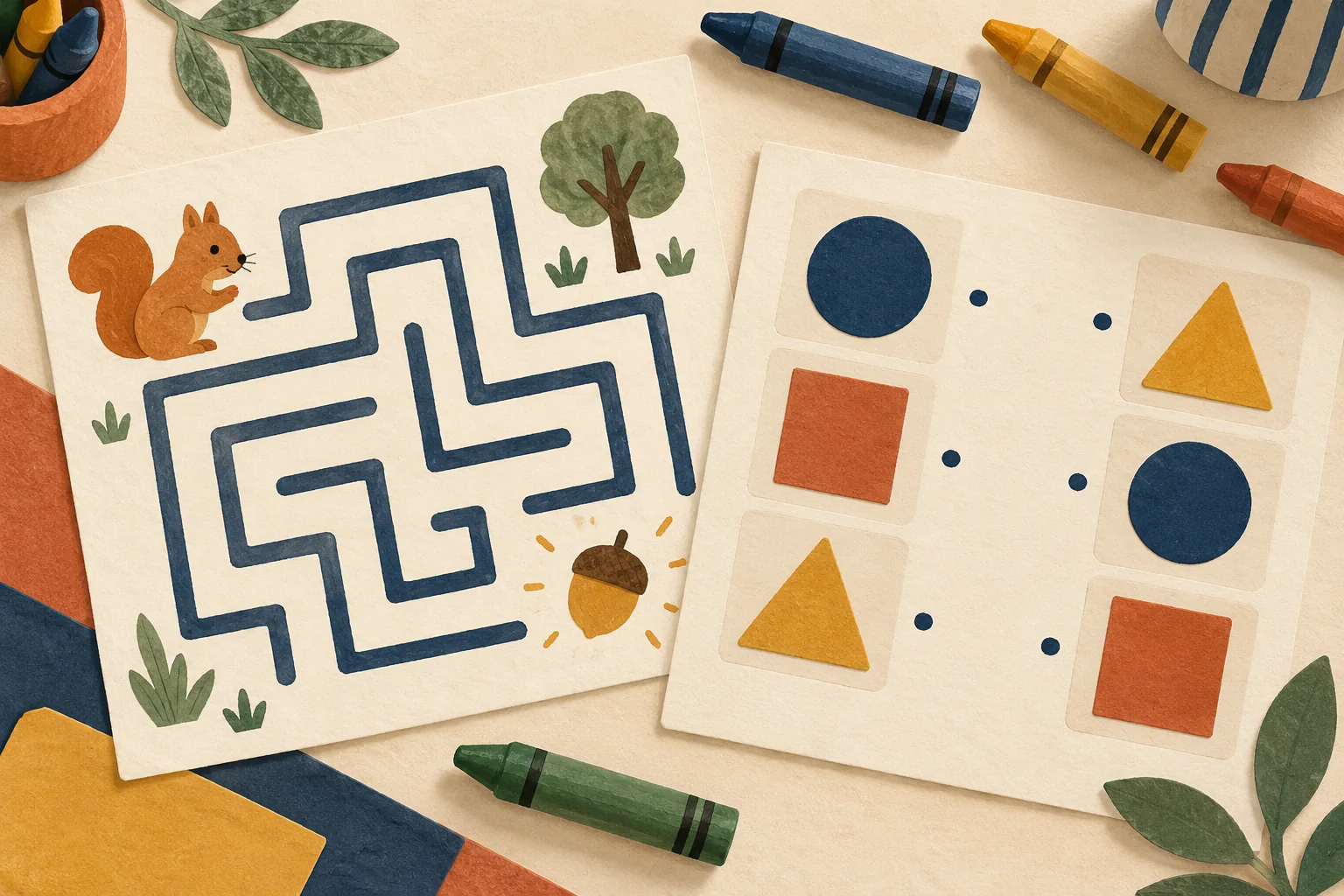
A printable activity succeeds when a child and the supporting adult can understand what to do, use the page comfortably, and recognize the intended result. Attractive artwork helps, but it cannot repair an unclear instruction or an exercise with no valid answer. Start with the learning task, then make the design serve that task.
This guide uses a fictional shape-matching activity to demonstrate the process. It is an editorial and production example, not a claim that one worksheet guarantees a developmental outcome. Individual children need different kinds of support, and a printable resource should leave room for an adult to adapt the experience.
Choose one observable task
Replace a broad goal such as “improve learning” with an action that can be seen. For the example, the task is to match three shapes with identical shapes. That is more precise than combining matching, counting, coloring, spelling, and tracing on the same page. Several activities can belong in a workbook, but each page needs a clear purpose.
Write down what the child must already understand and what support is expected. If an adult must read the instruction, say so in the resource notes. If the activity requires scissors or loose materials, account for preparation and appropriate supervision. Do not let a simple worksheet become dependent on supplies the buyer did not know were necessary.
Draft the instruction before the illustration
Use a direct action verb and identify the relevant objects. “Draw a line from each shape on the left to the same shape on the right” gives a clearer action than “Complete the fun matching challenge.” The second sentence describes the mood, but not the task. Read the instruction aloud to check whether it works naturally when an adult explains the page.
Keep separate actions in a sensible sequence. If the child must first cut cards and then sort them, present those as two steps. Avoid asking for a hidden action that only the designer knows is required. A useful review question is: could someone who has never seen the draft explain the task after reading the instruction once?
Make the example do real work
Include a completed example when it clarifies the process without giving away the entire activity. In a matching exercise, one sample pair can show where a line begins and ends. Make the example visually distinct from the items the child should complete. Otherwise the child may spend time trying to redo work that was intended as a demonstration.
Check that the example follows exactly the same rule as the remaining items. An example that matches by color while the rest of the page expects matching by shape introduces an unintended contradiction. When the rule changes later in a workbook, explain the change rather than relying on a new illustration style to communicate it.
Reduce unrelated visual demands
Leave enough space for the intended response. A page meant for drawing lines needs clear routes between items. A tracing page needs marks that remain visible after printing. Decorative objects should not resemble answer choices or compete with the task. Use a restrained layout so that the child can identify where to begin.
For the fictional activity, place three distinct shapes in each column with generous spacing. Avoid surrounding them with many similar decorative shapes. If color is not the learning target, make the activity understandable without color. Test a grayscale print and a photocopy because classroom and home printers may reproduce the page differently from a bright screen.
Check the answer logic independently
Solve the activity yourself, then ask another adult to solve it without explanation. Confirm that every question has the intended answer and that the artwork supports the rule. In a maze, trace a valid route. In a matching page, check for accidental duplicate choices. In a counting task, count every visible object after the final illustration is placed.
Keep an answer key where appropriate, especially for multi-page resources. The key should be generated from the final page version rather than an early draft. If an activity permits several valid responses, say so. A creative drawing prompt does not need a single correct answer, but its instructions still need to communicate the intended boundaries.
Review suitability with context in mind
The NAEYC developmentally appropriate practice statement emphasizes individual differences and the contexts in which children learn. For printable design, this supports a practical habit: consider the reader’s actual language, experience, and available support instead of treating an age range as a complete specification.
Offer useful adaptations when they preserve the goal. A child could point to matching shapes instead of drawing lines if pencil control is not the target. An adult might reduce the number of choices before introducing the full page. Describe these as options for using the resource, not as therapeutic interventions or guaranteed methods for a particular condition.
Prepare a usable print file
Choose the paper format and margins for the intended buyer, then test the export at actual size. Keep instructions away from edges that home printers may not reach. Verify that fonts are embedded or otherwise handled correctly in the final PDF, and that symbols have not been substituted. An editable source file and a print PDF serve different purposes; label them clearly if both are included.
Open the final file on another device and print representative pages. Check page order, clipped elements, faint lines, oversized ink-heavy areas, and blank pages. Our accessible educational content guide covers additional checks for reading order, text alternatives, and screen use. A print-friendly page is not automatically an accessible digital document.
Test the instructions in a real session
With appropriate caregiver permission, observe a short activity session. Record whether the child understands the task, which parts need explanation, and whether the physical layout interferes with the response. Do not coach every step and then conclude that the page is self-explanatory. Note the actual support provided so that the result is interpreted honestly.
Revise the page and test the changed instruction again. Keep a dated checklist covering purpose, instructions, example, answer logic, print quality, and support notes. Our children’s reading-age guide can help align the final description with the resource’s demands. A useful printable is a tested activity with a clear purpose, not simply an attractive page sold as educational.