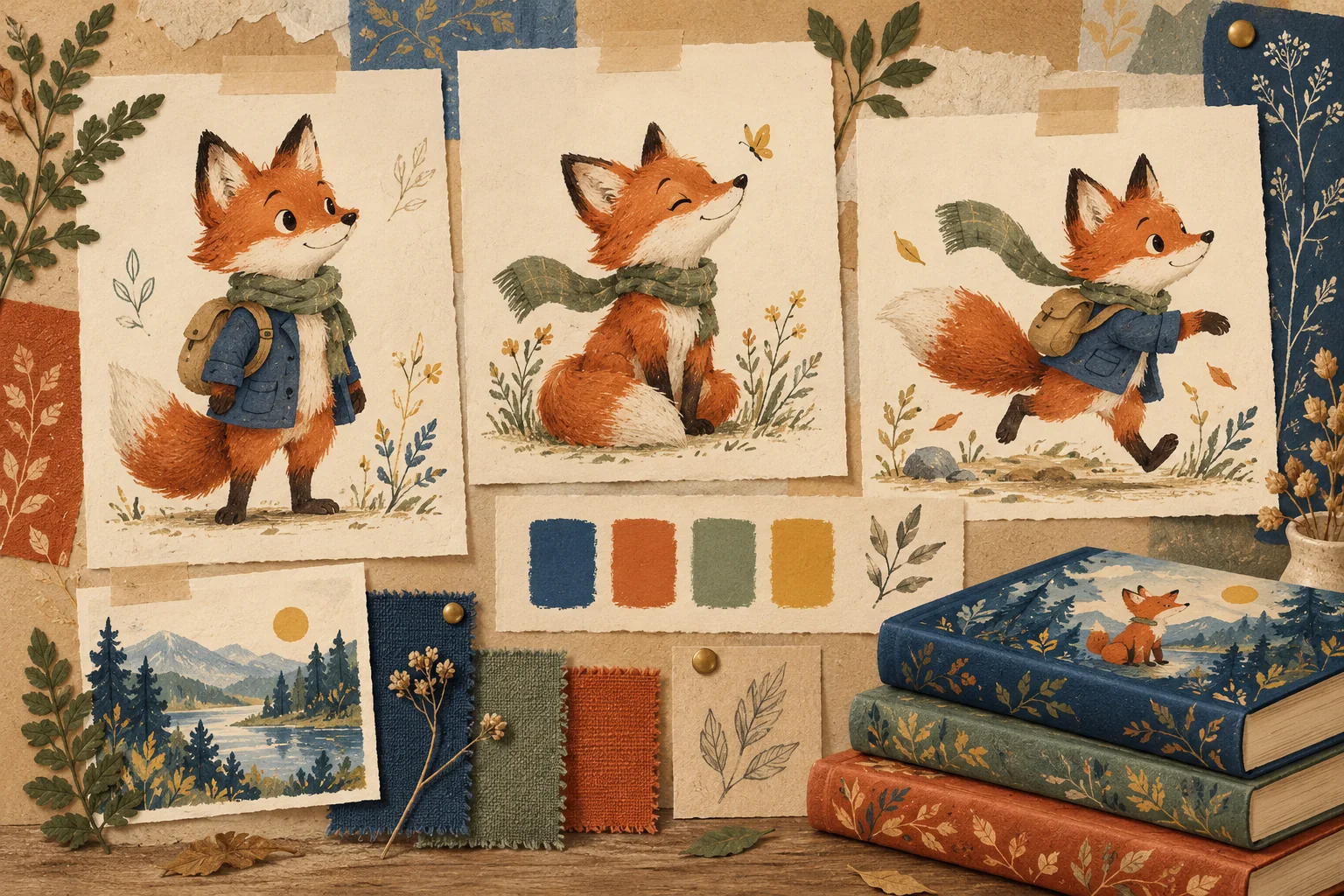
A children’s book series needs enough consistency for readers to recognize its world and enough variation for each title to feel worthwhile. A style guide records the decisions that should remain stable: characters, language, visual identity, page conventions, and production rules. It also identifies the parts that can change when a new story needs a different setting or rhythm.
The example here is a fictional woodland series featuring a fox with a green scarf. It is a planning model, not a description of an existing licensed character. The guide can be used by a solo creator or by a team working across writing, illustration, editing, and production.
Define the series promise
Write a short statement describing the audience, reading mode, tone, and recurring experience. “Gentle woodland adventures for shared reading, with a curious fox solving practical problems” gives collaborators a useful direction. “Fun books for all children” does not help resolve a scene that feels too frightening, too complicated, or unrelated to the series.
Add boundaries. Decide whether the world includes magic, whether animals use human tools, and how conflict is resolved. These decisions affect every future manuscript. Keep the statement short enough to consult during work. A style guide becomes less useful when its main purpose is hidden inside a long brand manifesto that contributors rarely read.
Create a character reference that can be checked
Include approved views of each recurring character, with notes on proportions, distinctive features, clothing, and essential colors. Show a small set of expressions and poses. Identify which details are fixed and which may vary. For the fox, the scarf might remain green while its position changes naturally with movement.
Avoid relying on a single dramatic cover image as the entire reference. Lighting and perspective can obscure the details an illustrator needs. Use clear reference views and record exceptions, such as a scene in which the character removes the scarf. A continuity note should explain the story reason, not merely label a different image as another acceptable version.
Specify the visual system
Record the working palette, illustration medium, line treatment, texture, and approach to backgrounds. Include actual color values where they help production, while recognizing that screen and print appearance can differ. Provide approved examples of a quiet scene, a busy scene, and a close-up so that style is demonstrated across several compositions.
Distinguish atmosphere from identity. A nighttime scene can change lighting without changing the character’s underlying design. A snowy title can introduce different scenery while retaining the series’ recognizable treatment. State these principles explicitly so that consistency does not become a demand to repeat the same camera angle and background on every page.
Document language and narration
Choose the language variety, narrator perspective, tense, and approach to dialogue. Record recurring names and the exact spelling of invented places. Include a short example of the intended voice and a contrasting example that feels wrong for the series. These samples should be written for the project rather than copied from another author’s work.
Decide how instructions, educational notes, and story text differ. If the series includes activities, keep the instruction verbs consistent where the tasks are the same. Our printable activity guide explains how direct wording supports usability. Do not let a decorative narrative voice make a simple activity instruction unnecessarily difficult to understand.
Make page conventions explicit
Record trim size, intended bleed setup, safe areas, title placement, body-text styles, and page-number treatment for each edition. Separate printer requirements from creative preferences. A series can have a consistent visual identity while using different technical exports for print and digital distribution. The source layout should not be treated as proof that every output file is correct.
Add rules for where essential text may appear relative to the binding and illustrations. Identify whether activities are single-page or spread-based. Our page-planning tutorial describes the inventory that links these decisions to actual page files. A stable page ledger prevents missing or duplicated content when work is delivered in batches.
Track assets and permissions
Keep an asset register listing illustrations, fonts, textures, and other materials used in the series. Record the creator or source, permitted use, relevant agreement, and where the proof of permission is stored. Do not assume that buying one file grants every possible print, digital, or merchandise use. Check the applicable terms and obtain clarification where needed.
The US Copyright Office’s general guidance explains the basic protection of original creative works. A series guide should therefore distinguish your own assets from third-party references. Inspiration images are not automatically licensed production assets. Keep references separate so that a collaborator does not accidentally include them in the final book.
Establish an approval sequence
Approve character design before large batches of final artwork. Approve the storyboard before polishing every scene. Review text and rough images together before final page export. Each stage should resolve a different type of uncertainty. Skipping directly to finished pages can make structural corrections expensive and encourage the team to retain weak scenes simply because they are already illustrated.
Use a small set of statuses: planned, drafted, under review, approved, and needs correction. Record who approved the work and which version they saw. If the cover is used as a visual reference, identify its exact approved file. Reattaching an older image should not silently reset the reference or the page sequence.
Allow controlled exceptions
A useful guide includes a place for exceptions rather than pretending every story will fit the original rules perfectly. Record the proposed change, the reason, the affected pages, and whether it applies only to one title or to the whole series. A winter coat may be a story-specific costume; a new eye shape may be an unintended character redesign.
Review exceptions at the end of each book. Incorporate improvements into the guide only when they are deliberate. Keep previous versions so that an older title can be revised consistently. This creates a record of the series’ development without requiring every collaborator to reconstruct decisions from scattered messages and image folders.
Test the guide with a small assignment
Give a collaborator one short scene using only the guide and the manuscript brief. Review the result for questions the documentation failed to answer. Add the missing clarification, then repeat with a different type of scene. A guide is effective when it supports correct decisions in real work, not merely when it looks polished.
Before starting another title, confirm that the new story offers a distinct experience within the shared world. Consistency should help readers recognize a series they enjoy. It should not become a shortcut for producing near-identical books with different covers. Keep the creative promise, the production record, and the reader’s experience aligned.